.svg)
.svg)
.svg)


%202.svg)
Church and Nonprofit Roofing: What Makes These Projects Different
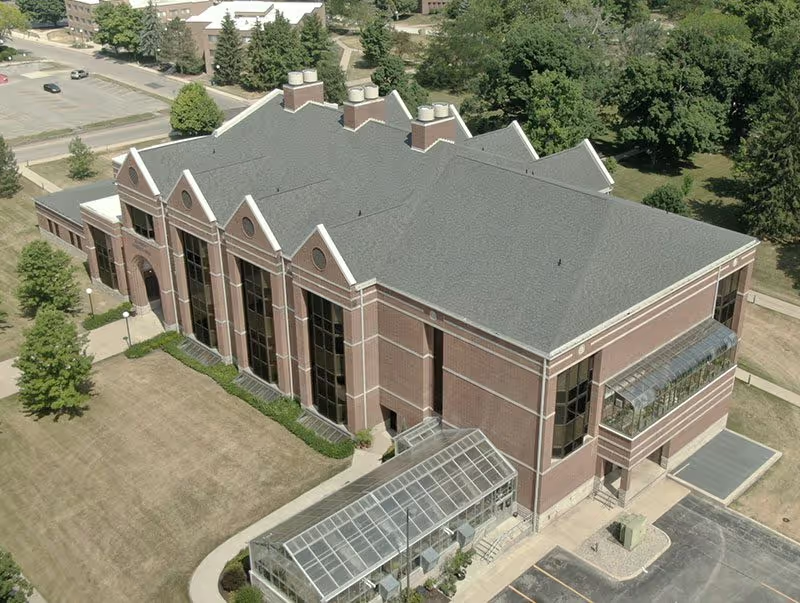
Church and nonprofit roofing projects differ from standard commercial work in a few specific ways. For one thing, buildings are often older and carry mixed roof systems that require more than one type of expertise.
Beyond that, major expenditures go through a board or committee approval process that runs on its own calendar, which means planning has to start earlier than most facilities contacts expect. And the coordination burden on-site is higher than on a typical commercial building, because there's rarely a dedicated facilities manager available to interface with the crew throughout the project.
A contractor who understands these factors can structure the project around them. One who doesn't tends to create friction at every stage.
Why Roof Systems on Older Religious Buildings Are More Complex
Many churches occupy buildings that were constructed in stages over decades. A single campus might have a flat membrane roof over a fellowship hall built in the 1980s, a metal standing-seam addition from the early 2000s, and original slate or clay tile on a sanctuary that predates both. Each of those systems has different inspection requirements, different failure modes, and different replacement considerations.
This matters practically when it comes to choosing a contractor. A roofer with expertise in flat membranes may have limited experience with tile, and vice versa. Coordinating separate contractors for each roof type creates handoff problems and makes it harder to establish accountability when something goes wrong at a transition point between systems. A single contractor with crews trained in each roofing type can assess the full scope of the building, sequence the work, and take ownership of the outcome across all of it.
It also matters for condition assessment. A membrane section and a slate section age differently and fail differently. An inspection report that treats the whole campus as a single system, rather than separate roofs that happen to be on the same property, gives a facilities committee a more accurate picture of where the money actually needs to go.
How Budget Planning Works Differently for Nonprofits
A church or nonprofit does not have a facilities director with discretionary capital sitting in reserve. Any expenditure above a certain threshold goes to a board, a building committee, or in some cases a congregational vote. Those approval processes run on a quarterly or annual calendar, and the documentation required to make the case internally is more formal than most facilities decisions at a private company.
A written inspection report with photographs does a specific job in this context. It gives the committee something to review that doesn't depend on taking a contractor's verbal assessment on faith. A condition report that distinguishes what needs attention now from what can be monitored for another year or two is more useful than a proposal that positions everything as urgent. Boards respond better to a clear hierarchy of need than to a single large number with a recommendation to act immediately.
For churches carrying deferred maintenance, which is common when resources have been directed toward programming or other priorities, the inspection report also helps establish a realistic multi-year plan. Not everything has to be addressed at once, and a contractor willing to say that clearly tends to earn more trust than one who treats every condition as a replacement trigger.
What Project Coordination Looks Like on a Larger Campus
Church campuses present logistical considerations that don't come up on a standard commercial job, and most of them trace back to the same basic fact: the building is in active use. Parking areas and entry paths used by staff and volunteers during the week need to stay accessible, and work has to be scheduled around services, midweek programming, and facility rentals. That means the contractor needs to understand the building's calendar before setting a project schedule, not after.
Access across a larger footprint also requires more advance planning. Multiple roof sections on separate structures, or on a building with an irregular layout, means crew positioning and material staging have to account for landscaping, covered walkways, and other site-specific constraints that aren't typical on a flat commercial building with a single accessible roofline.
Dedicated project supervision matters here more than it does on a simpler job. When there's a named supervisor who coordinates directly with the church's point of contact, questions get answered without delaying work, and the congregation's staff isn't left trying to figure out who to call when something comes up mid-project. It also means the work gets scheduled around the building's actual activity calendar rather than the contractor's default preference.
When to Start the Planning Conversation
Summer is when most churches schedule major facility work, typically during lower-activity periods between programming seasons. But the internal approval process means the planning conversation has to happen in spring.
A board that doesn't have an inspection report and a written scope until June is realistically looking at fall at the earliest before work begins, assuming the approval cycle takes the time it usually does. Starting the inspection in March or April, with a condition report delivered in time for a spring board meeting, keeps the project on a summer timeline.
The inspection itself is the low-commitment starting point. It produces a document the facilities committee can use internally, regardless of what they decide to do next or when.
If you manage a church or nonprofit property and want a written assessment of where your roof stands, get started here.

.avif)


